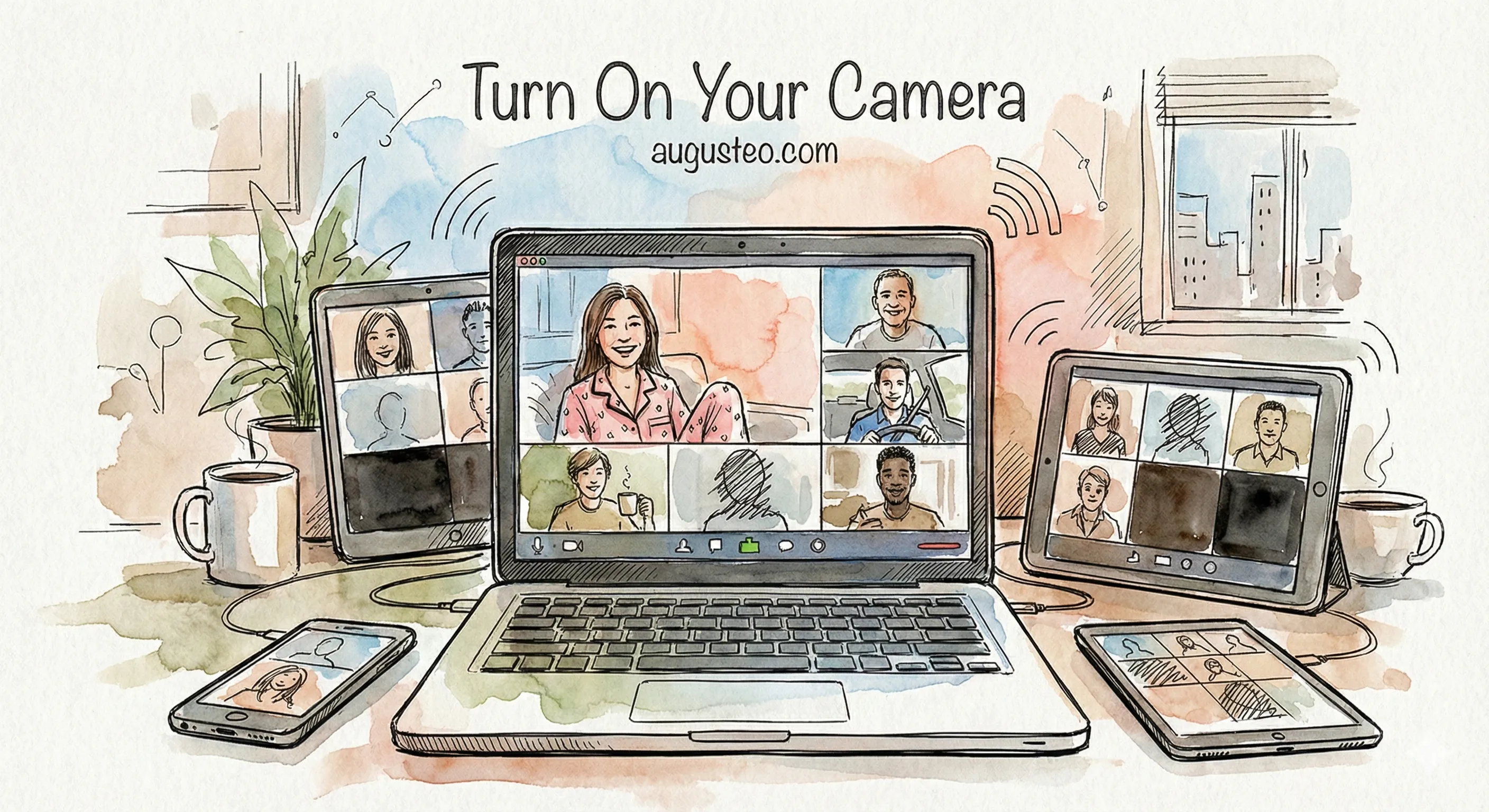
I’ve been working remotely for years now, and there’s one thing I keep noticing: fewer and fewer people turn on their cameras during video calls. And I get it. Zoom fatigue is real. But here’s the thing: the benefits of having your camera on far outweigh the costs.
This isn’t about looking polished or having a nice background. It’s about building trust, staying accountable, and actually connecting with your teammates in an environment where we’re already operating at lower bandwidth than in-person work.
Let me break this down.
The Benefits for You
When you turn on your camera, people remember you. It’s just human nature.
Think about a meeting with 10 people where only 5 have their cameras on. Your eyes naturally go to those 5 faces. You build a mental image of who they are. The other 5? They’re technically there, but you don’t feel their presence the same way.
If you’re a junior employee trying to make an impression, this matters a lot. Leaders notice who shows up. Not just who attends the meeting, but who shows up.
Having your camera on also gives context. When I’m driving and can’t fully participate, I still hold my phone up so people can see I’m in the car. Now they understand where I am. They set expectations accordingly. It builds another layer of trust.
This matters because remote work doesn’t have the “water cooler chatter” of an office. We don’t bump into each other in hallways. We don’t grab coffee together. The camera is one of the few ways we can share a bit of who we are beyond just our voices.
The Benefits for Your Teammates
Communication over video is already limited compared to being in person. When you add your face to the call, you’re giving your teammates more information to work with.
They can see you nod in agreement. They can catch you furrowing your brow in confusion. They can tell when you’re engaged versus when you’re zoning out. These cues matter. Non-verbal communication makes up a huge part of how humans understand each other.
It also makes meetings less awkward. There’s nothing worse than presenting to a wall of black rectangles. Some of my coworkers call this “talking to the void.” When people have their cameras off, the speaker has no feedback. No reactions. Nothing. It’s honestly kind of depressing.
When you turn on your camera, you’re showing respect for the people presenting. You’re signaling that this meeting matters, that their time matters, that you’re actually there with them.
The Downsides of Keeping Your Camera Off
We’ve all been in that meeting. Someone has their camera off. Their name gets called. Silence. Then after a few seconds: “Hey, can you repeat the question please?”
It’s obvious they were doing something else. And look, I understand that multitasking is hard to avoid in modern work. But when your camera is off, it’s way easier to drift. When your camera is on, your brain treats the meeting differently. You’re more present. You’re more focused.
Research backs this up too. People who keep cameras off are often perceived as less engaged, less trustworthy, and less suited for leadership roles. Fair or not, your teammates and your managers notice.
Here are some findings:
- A Vyopta survey found that 92% of executives think workers who turn cameras off don’t have a long-term future at the company.
- A Korn Ferry survey found that 76% of professionals believe people who leave cameras off are looked upon negatively, and 60% say it’s a “career minimizing move.”
- Research published in the European Journal of Social Psychology found that turning your camera off results in being perceived as less engaged, less moral, and less suitable for leadership.
You can either accept human nature or fight against it. But you’re probably going to lose if you try to fight it.
But What About Zoom Fatigue?
I hear this one a lot. “Cameras are exhausting.”
And yes, there’s research showing that being on camera can increase fatigue, I’m not dismissing that.
But here’s my take: everything in life is a cost-benefit analysis.
Sure, being on camera takes energy. But the trade-off is that your teammates trust you more. Your managers remember you. You build relationships. You stay focused. Those benefits are significant.
If you’re worried about how you look, don’t be. I’ve been in meetings in my pajamas plenty of times even at Apple. Let alone at startup. Nobody cares. People sometimes say it’s cute, but it’s genuinely not an issue. You’re not in an interview anymore. You’re not trying to impress people with your appearance. You’re trying to build something together.
If you’re worried about your living space, use a virtual background. Problem solved.
My Personal Rule
I turn my camera on about 95% of the time. The only times I don’t are when I physically can’t, like when I’m driving through a tricky area where Tesla FSD isn’t handling things well and I need both hands on the wheel.
Even when I’m driving on easier roads, I’ll hold my phone to show my face so people have context. They can see I’m in transit. They understand the situation.
I’d advocate the same for everyone working remotely. If you want to build relationships, if you want people to trust you, if you want to be remembered, just turn it on. It’s fine. Really.
For Leaders
If you’re a manager or team lead, this applies to you too. Maybe even more so.
You set the example. If you have your camera on, your team is more likely to follow. If you’re always camera-off, don’t be surprised when everyone else does the same.
Advocate for cameras-on culture in your team. Not as a rigid mandate, but as a norm. Explain why it matters. Make it clear that nobody’s judging appearances or backgrounds. What matters is that you’re present with each other.
Final Thoughts
Remote work is already lower bandwidth than being in person. We lose the hallway conversations, the lunch chats, the accidental run-ins that build relationships over time.
The camera is one of the few tools we have to close that gap. It lets people see your face, read your expressions, and feel like they’re actually talking to a person rather than a name on a screen.
If you don’t care about your career, if you’re already looking for another job, sure, keep your camera off. But if you want better relationships with your teammates, if you want your leaders to remember you, if you want to actually be present in your work, just turn it on.
It’s not about looking perfect. It’s about showing up.
My rule: 95% cameras-on. The other 5% is when I literally can’t. Try it for a month and see if your meetings feel different.