This is a summary post for my own archive. All images are generated with Nano Banana Pro - All words are generated with Claude
https://www.youtube.com/watch?v=kLe-zy5r0Mk
🎯 Core Message
This conversation with Stewart Butterfield, founder of Flickr and Slack, reveals a comprehensive product philosophy centered on utility curves, eliminating user friction through comprehension rather than just speed, and relentless focus on craft. Butterfield argues that most product failures stem from insufficient investment in reaching the “steep part” of the utility curve, organizational bloat that creates “hyperrealistic work-like activities,” and the “owner’s delusion” that prevents teams from understanding users’ actual needs and contexts.
📊 Comprehensive Key Points
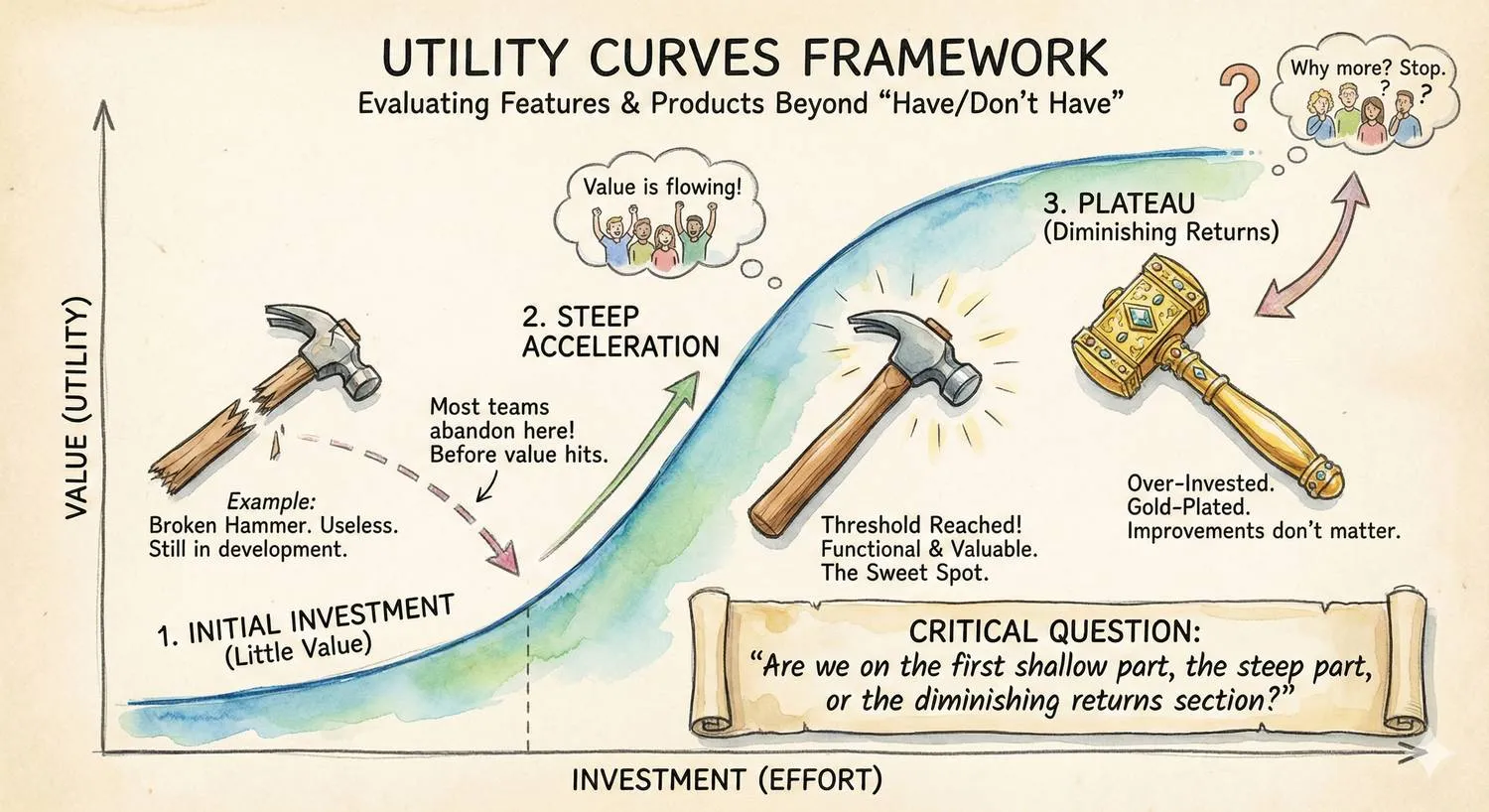
- Utility Curves Framework: The foundational concept Butterfield uses to evaluate features and products
- Features aren’t binary (have/don’t have) but exist on an S-curve of value
- Initial investment produces little value, then hits a steep acceleration, then plateaus
- Most teams abandon features before reaching the steep part of the curve or over-invest past diminishing returns
- Example: A hammer with a handle that breaks is useless; slightly stronger is still useless; at some threshold it becomes good; beyond that, improvements don’t matter
- Critical question: “Are we on the first shallow part of the curve, the steep part, or the diminishing returns section?”
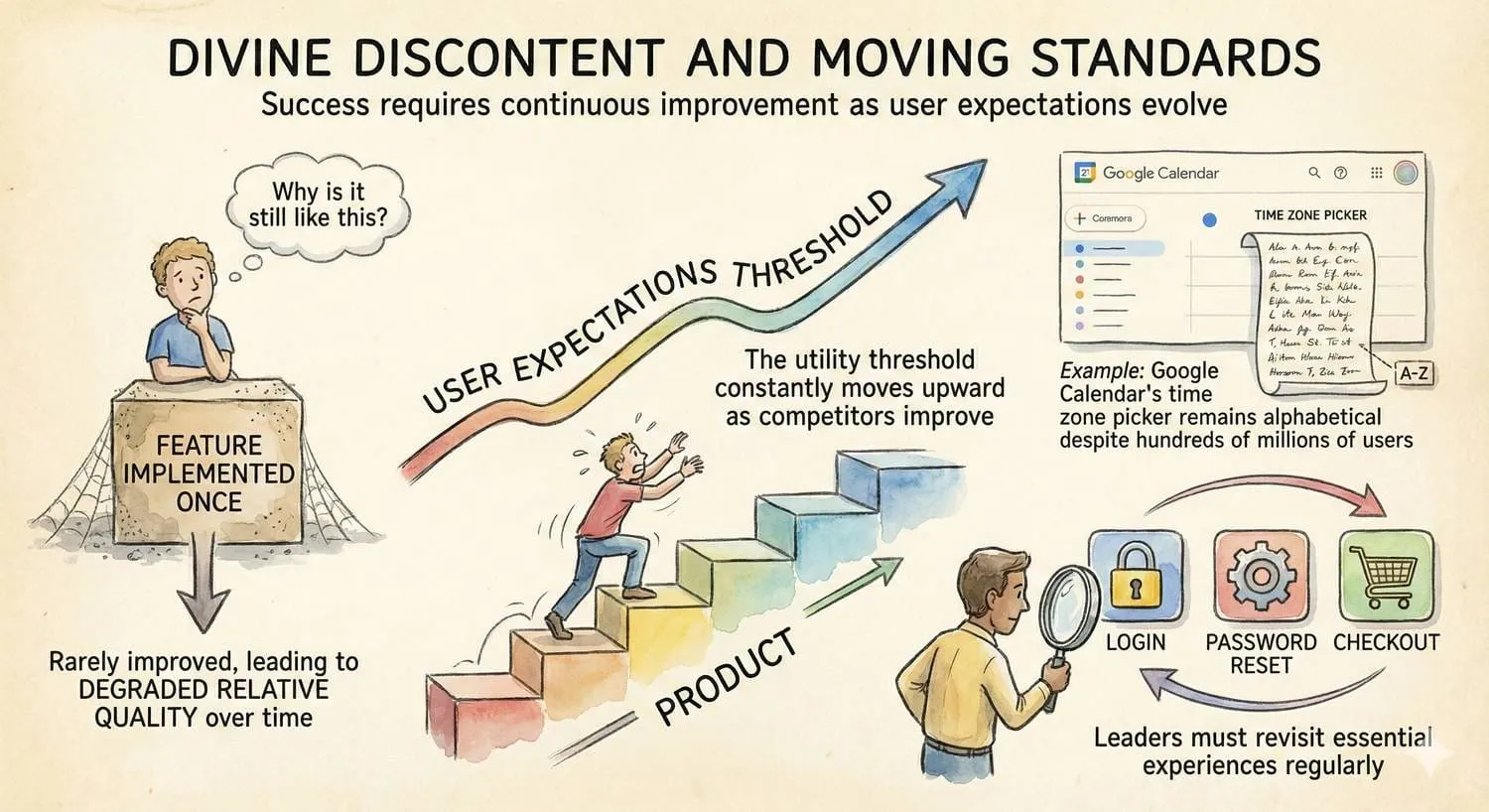
- Divine Discontent and Moving Standards: Success requires continuous improvement as user expectations evolve
- The utility threshold constantly moves upward as competitors improve
- Features implemented once rarely get improved, leading to degraded relative quality over time
- Example: Google Calendar’s time zone picker remains alphabetical despite being used by hundreds of millions
- Leaders must revisit essential experiences (login, password reset, checkout) regularly
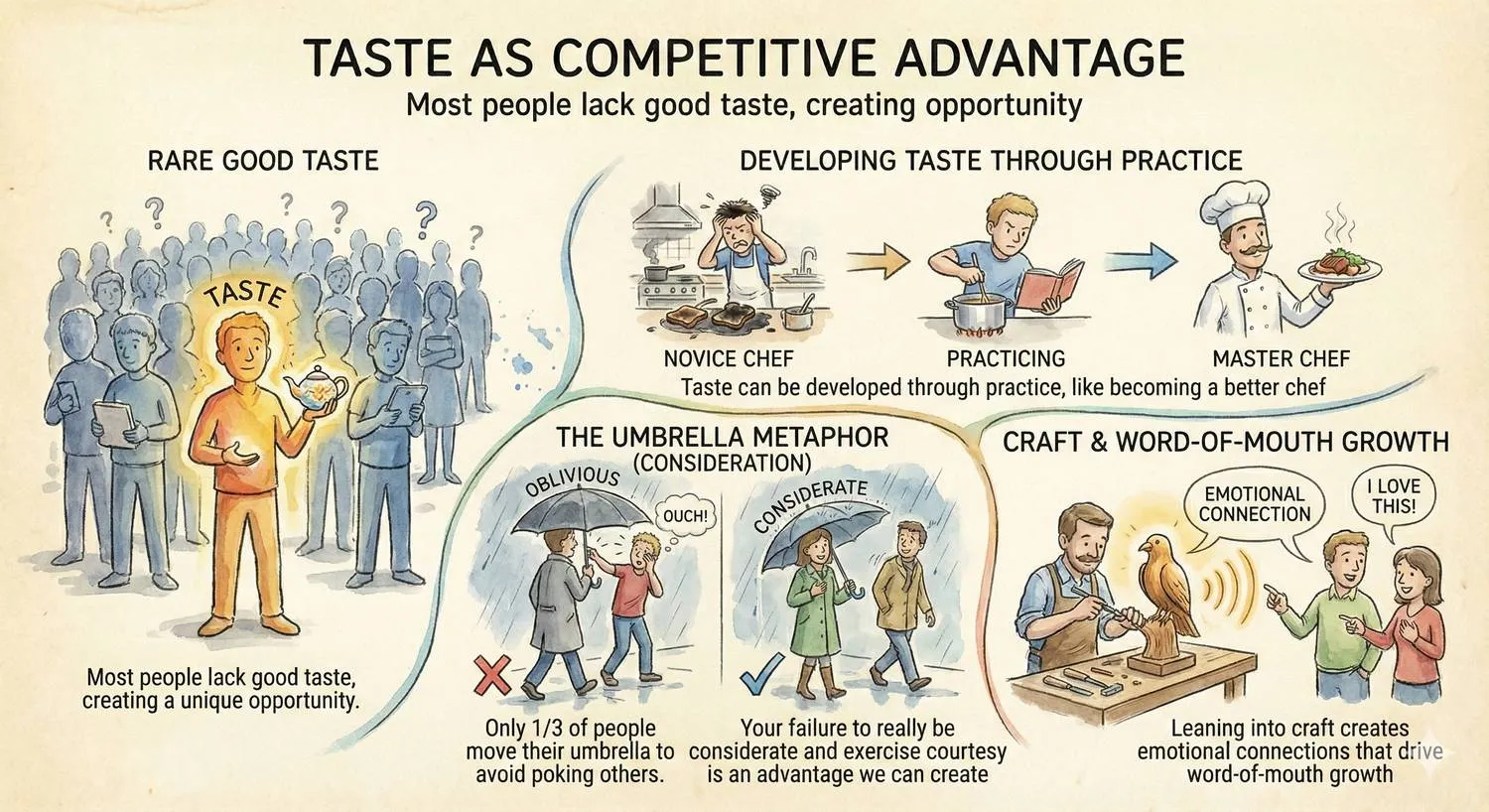
- Taste as Competitive Advantage: Most people lack good taste, creating opportunity
- Taste can be developed through practice, like becoming a better chef
- The “tilting your umbrella” metaphor: Only 1/3 of people move their umbrella to avoid poking others
- “Your failure to really be considerate and exercise courtesy is an advantage [we] can create”
- Leaning into craft creates emotional connections that drive word-of-mouth growth
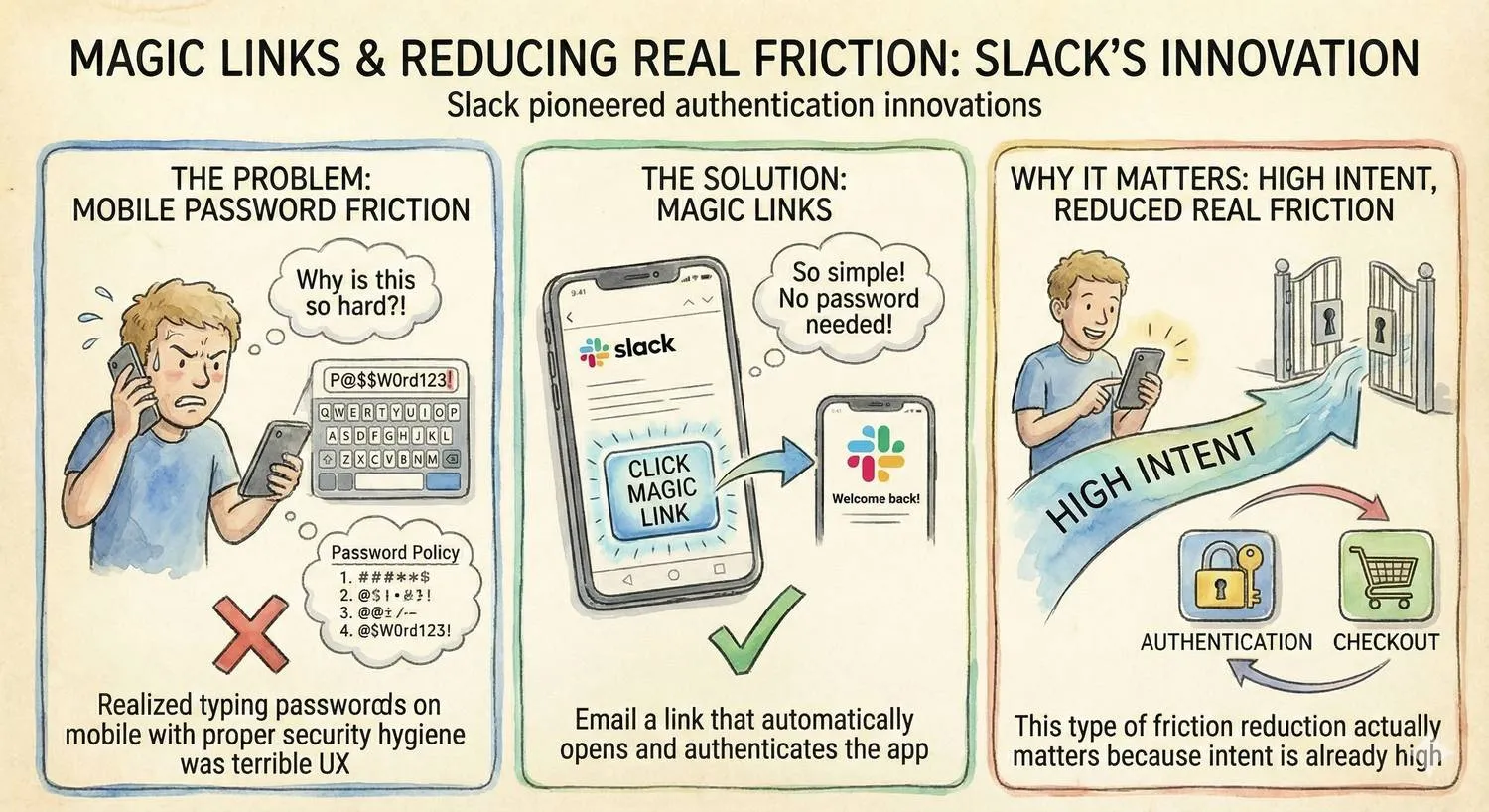
- Magic Links and Reducing Real Friction: Slack pioneered authentication innovations
- Realized typing passwords on mobile with proper security hygiene was terrible UX
- Solution: Email a link that automatically opens and authenticates the app
- This type of friction reduction (in authentication, checkout) actually matters because intent is already high
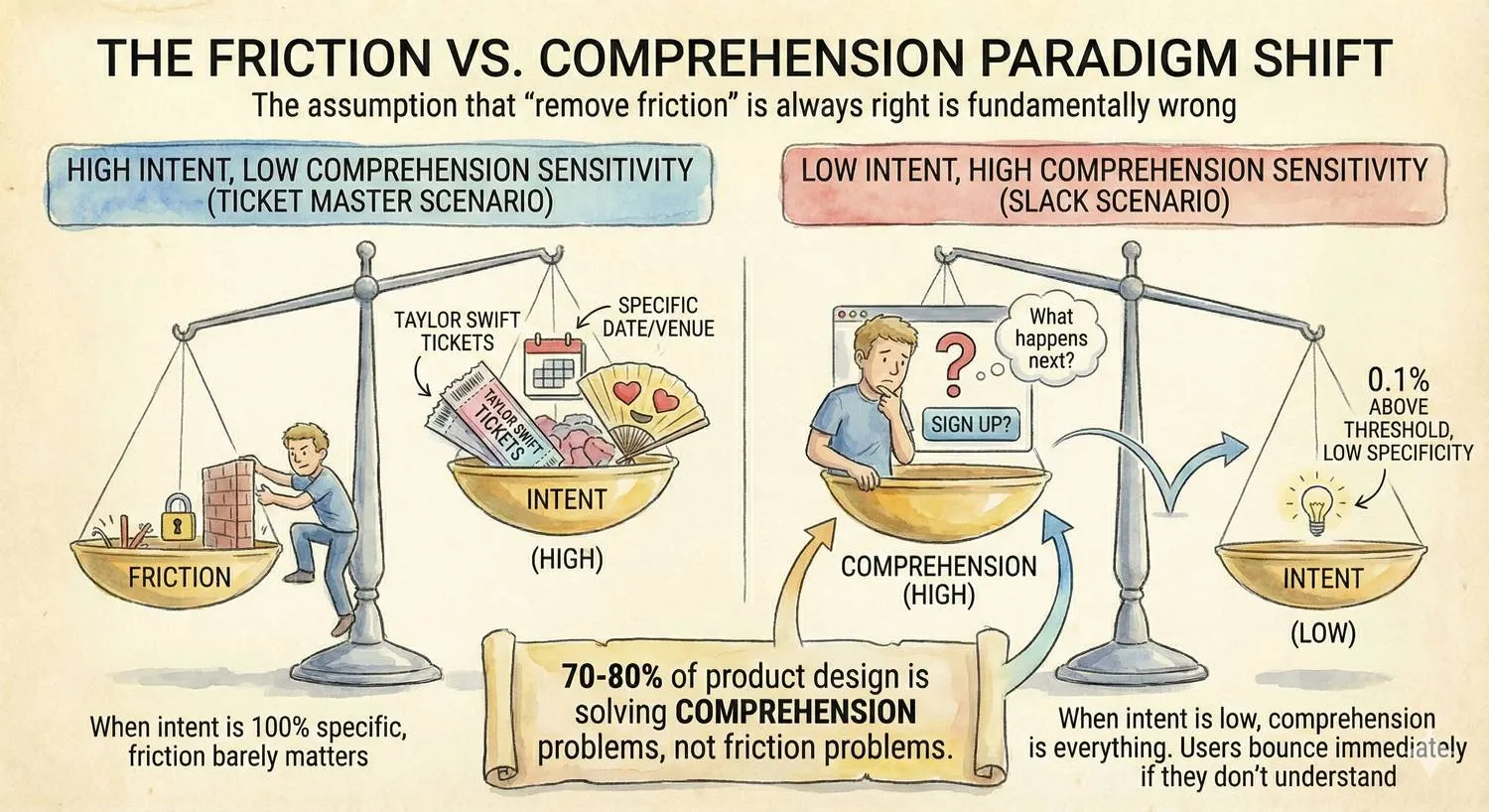
- The Friction vs. Comprehension Paradigm Shift: The assumption that “remove friction” is always right is fundamentally wrong
- Ticket Master scenario: When intent is 100% specific (Taylor Swift tickets, specific date/venue), friction barely matters
- Slack scenario: When intent is 0.1% above threshold and specificity is low, comprehension is everything
- If users don’t understand what they’re signing up for or what happens next, they’ll bounce immediately
- 70-80% of product design is solving comprehension problems, not friction problems
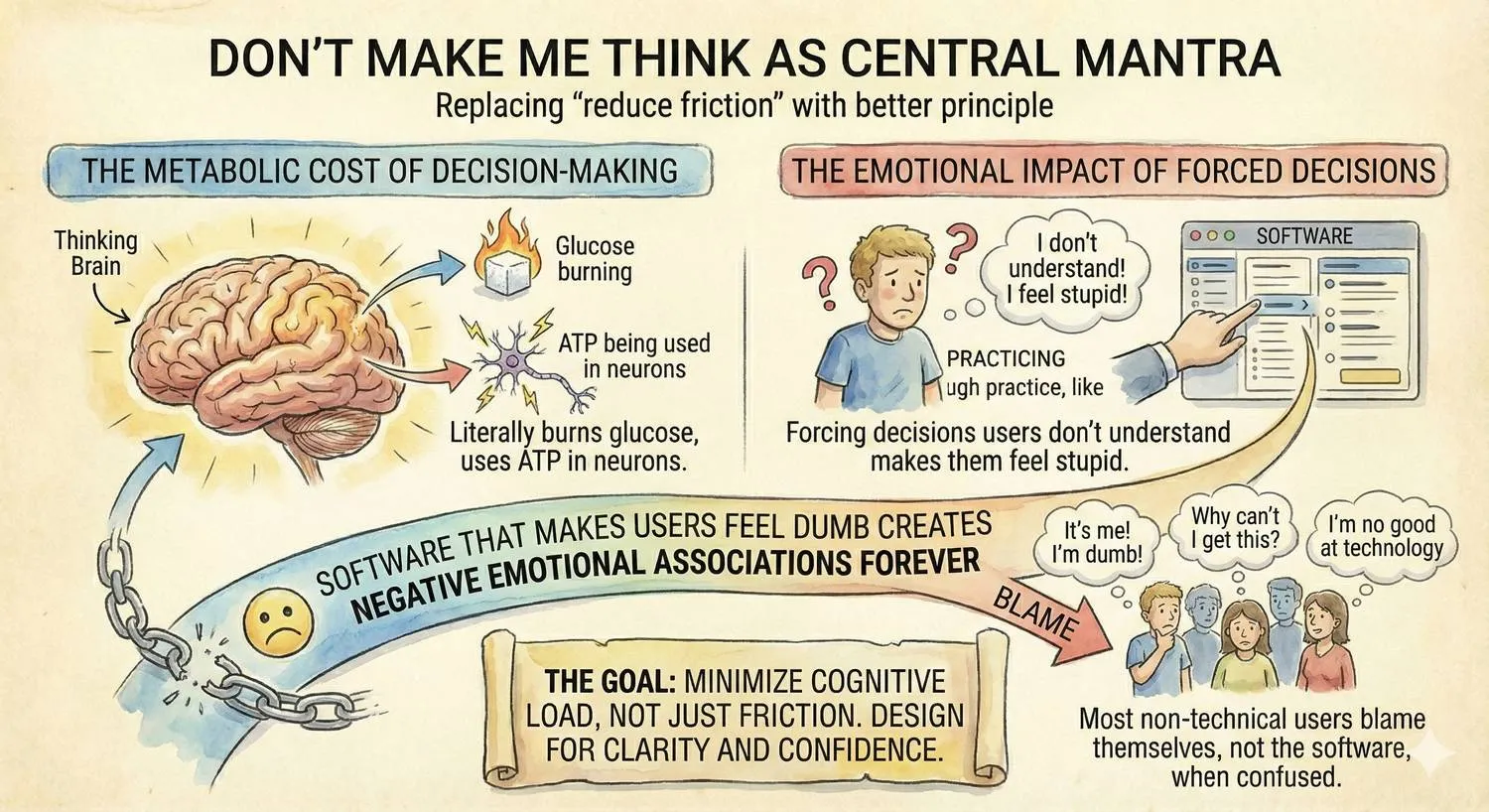
- “Don’t Make Me Think” as Central Mantra: Replacing “reduce friction” with better principle
- Decision-making has metabolic cost (literally burns glucose, uses ATP in neurons)
- More importantly, forcing decisions users don’t understand makes them feel stupid
- Software that makes users feel dumb creates negative emotional associations forever
- Most non-technical users blame themselves, not the software, when confused
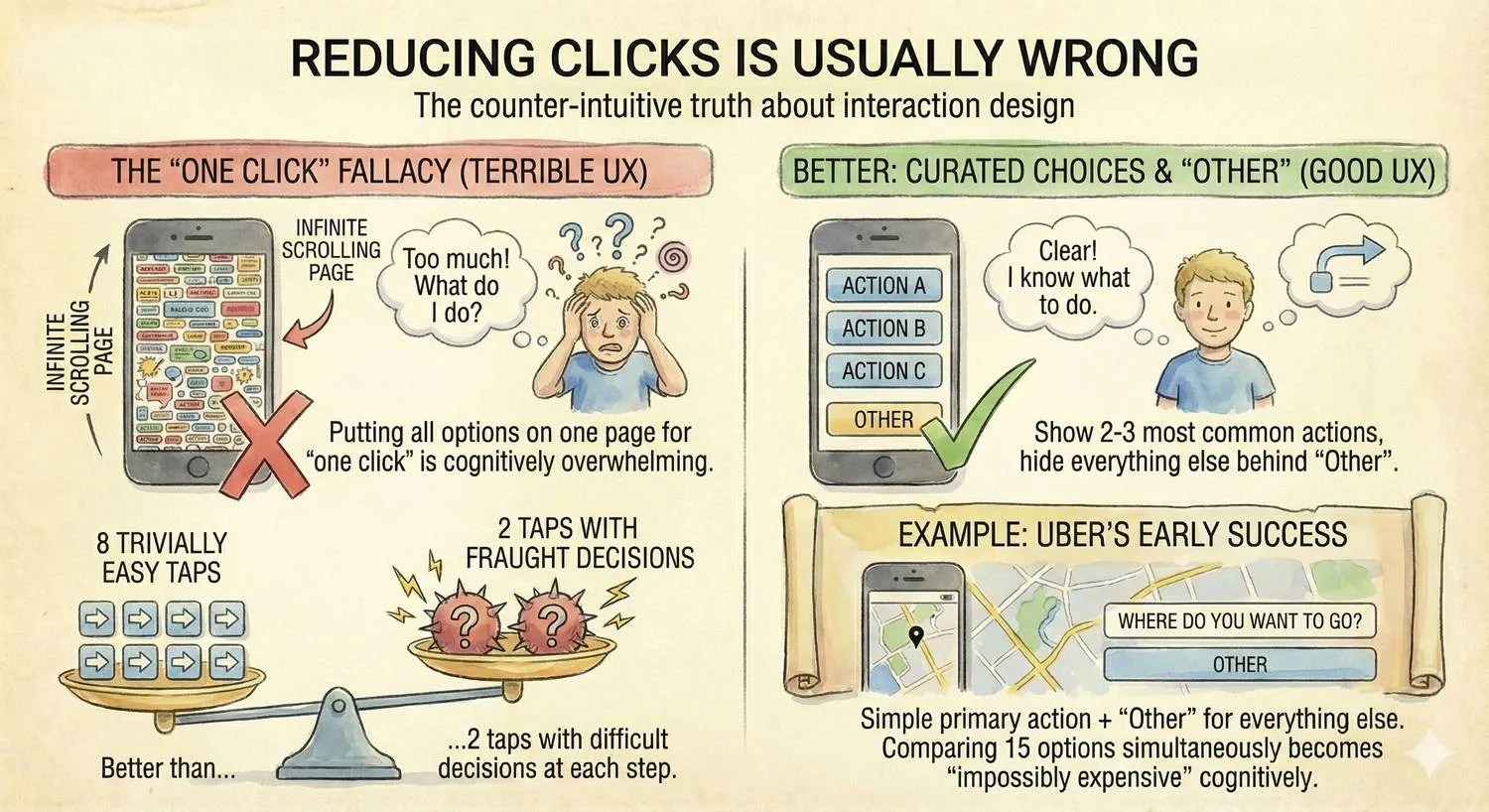
- Reducing Clicks is Usually Wrong: The counter-intuitive truth about interaction design
- You could make everything one click by putting all options on one infinite scrolling page (obviously terrible)
- Better: Show 2-3 most common actions, hide everything else behind “Other”
- 8 trivially easy taps is better than 2 taps with fraught decisions at each step
- Comparing 15 options simultaneously becomes “impossibly expensive” cognitively
- Example: Uber’s early success with simple “Where do you want to go?” + “Other” for everything else
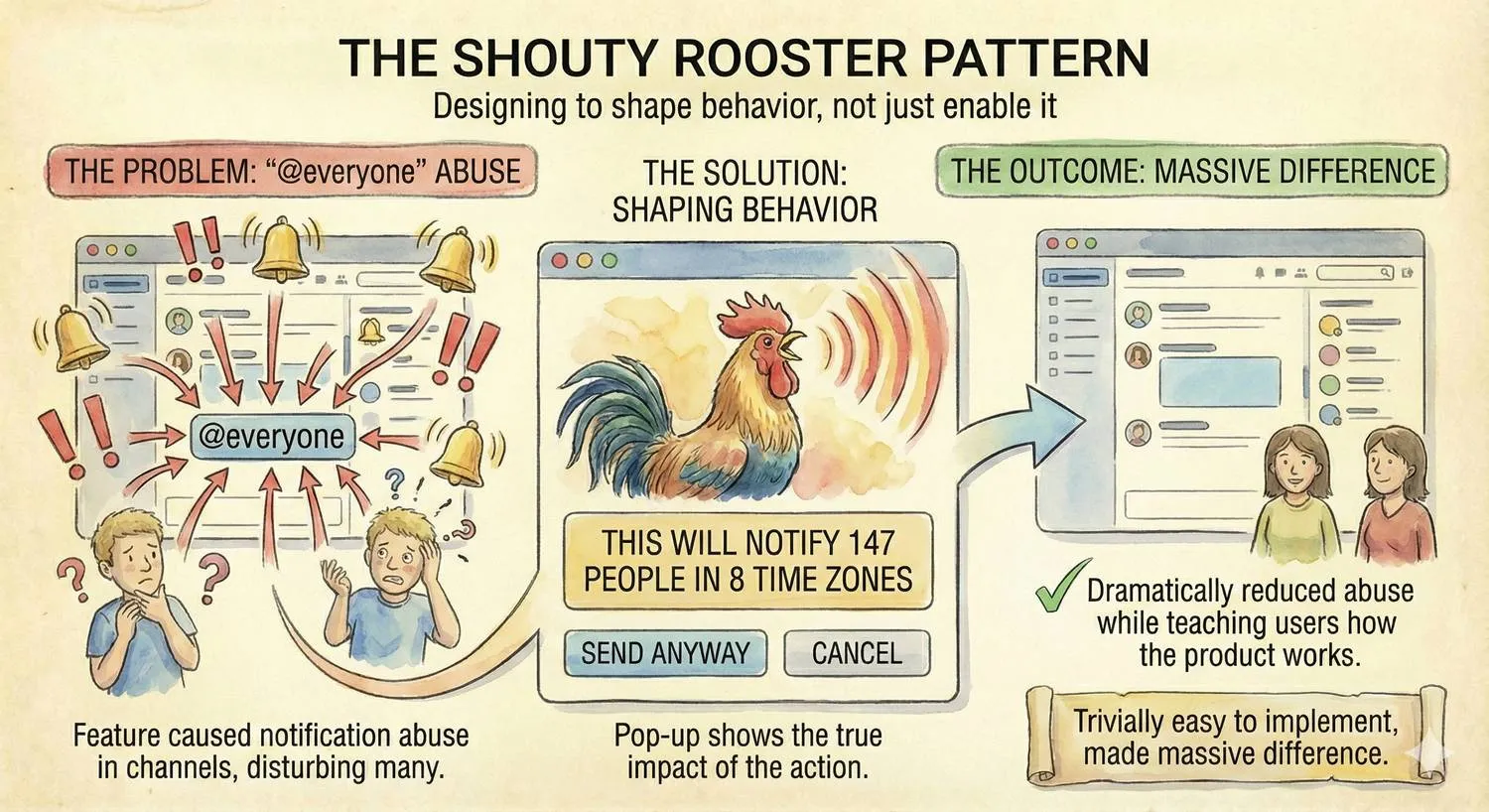
- The Shouty Rooster Pattern: Designing to shape behavior, not just enable it
- @everyone feature caused notification abuse in channels
- Solution: Pop-up showing a rooster with sound waves: “This will notify 147 people in 8 time zones”
- Dramatically reduced abuse while teaching users how the product works
- Trivially easy to implement, made massive difference

- Do Not Disturb Rollout: Complex change management done right
- Warned admins weeks in advance
- Set org-wide defaults (7pm-7am or 8pm-8am in local timezone)
- Admins could override, users could override admin settings
- If admin changed policy again, it would overwrite user preferences (but users could change back)
- Without defaults, most people would never enable it themselves
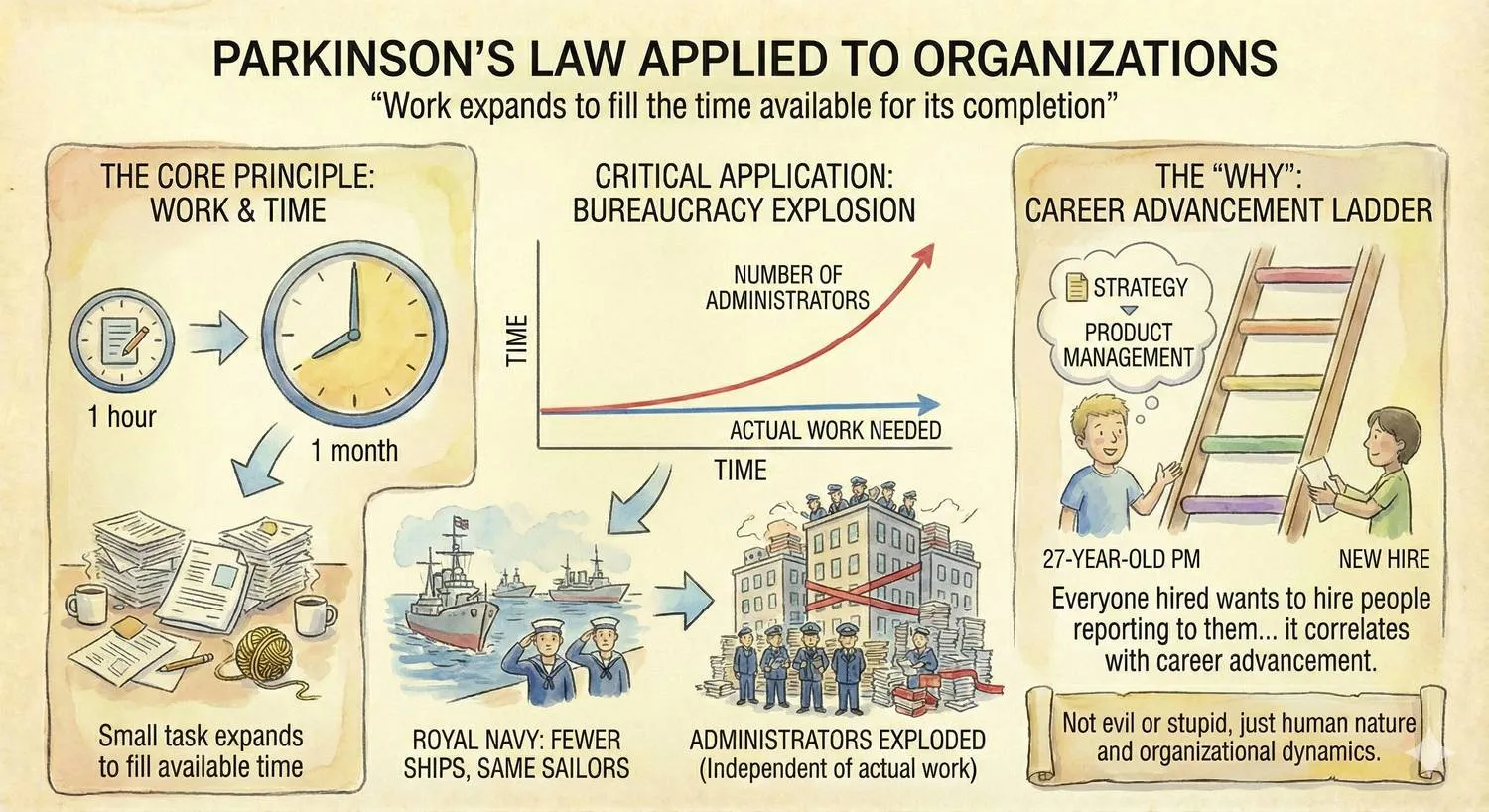
- Parkinson’s Law Applied to Organizations: “Work expands to fill the time available for its completion”
- More critically: The number of administrators grows independent of actual work needed
- Example: Royal Navy ships decreased, sailors stayed flat, administrators exploded
- Everyone hired wants to hire people reporting to them - not because they’re evil or stupid, but because it correlates with career advancement
- 27-year-old PMs immediately want to hire someone: “They would do product management, I would do strategy”

- Hyperrealistic Work-Like Activities: Butterfield’s most damning critique of organizational dysfunction
- Early startups have abundant “known valuable work to do” (open bank account, create users table, etc.)
- As companies grow: supply of valuable work decreases, demand for work (number of people) increases
- Result: People perform activities that look exactly like work but accomplish nothing
- Examples: Meetings to preview decks for other meetings, elaborate feature flags for insignificant changes
- The @person-in-thread example: Thousands of person-hours for 2.17 vs 2.14 messages average (statistically insignificant)
- It’s the leader’s responsibility to ensure “sufficient supply of known valuable work to do”
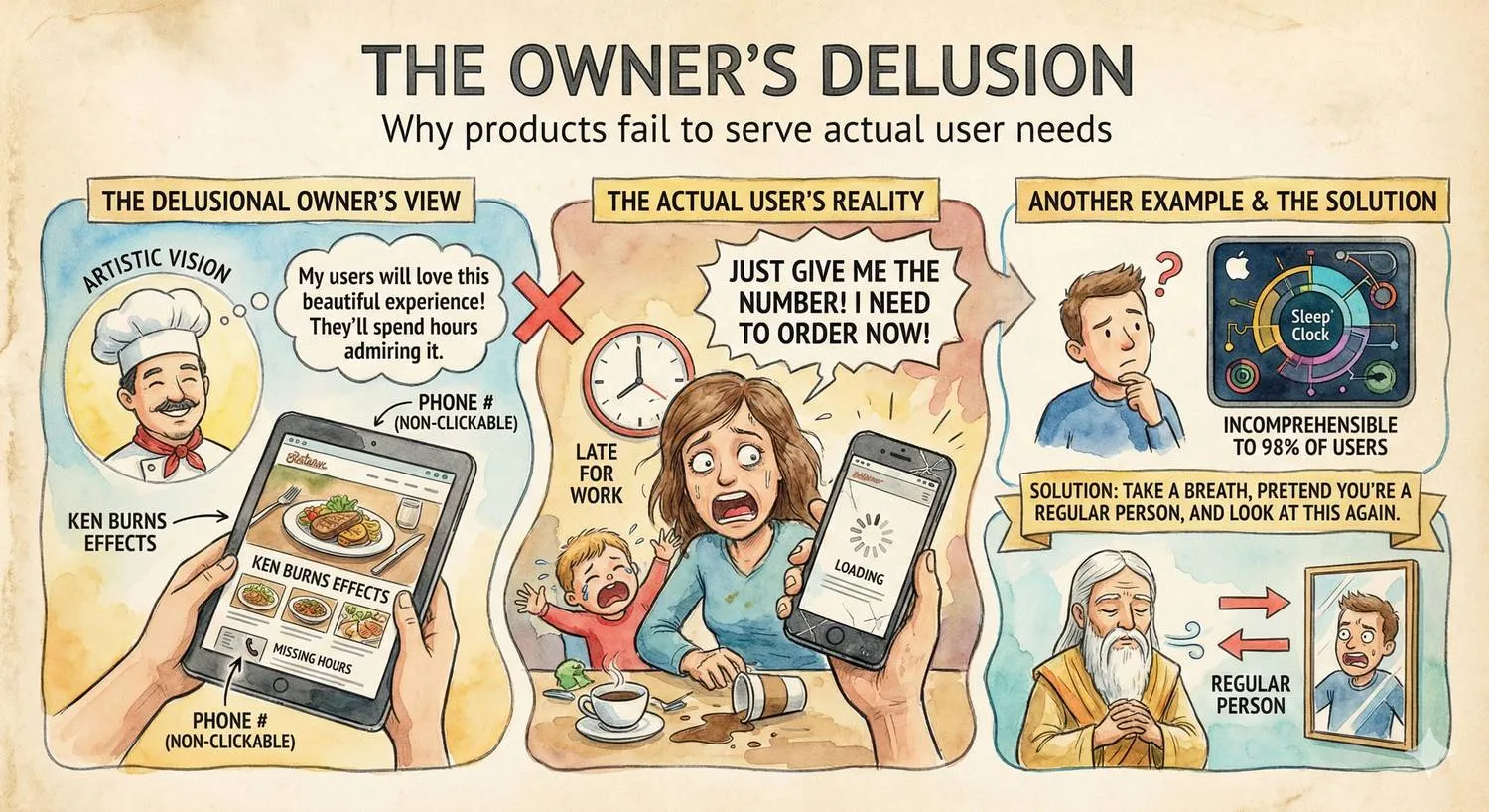
- The Owner’s Delusion: Why products fail to serve actual user needs
- Restaurant websites with slow-loading Ken Burns effects, non-clickable phone numbers, missing hours
- The owners have definitely wanted to find a phone number on someone else’s restaurant website
- Yet they create the same terrible experience for their users
- Apple’s “Sleep” feature in Clock app - incomprehensible to 98% of users
- Users are “at work, late this morning, need to go to the bathroom, concerned about their kids” - not sitting attentively in a theater
- Solution: “Take a breath, pretend you’re a regular person, and look at this again”
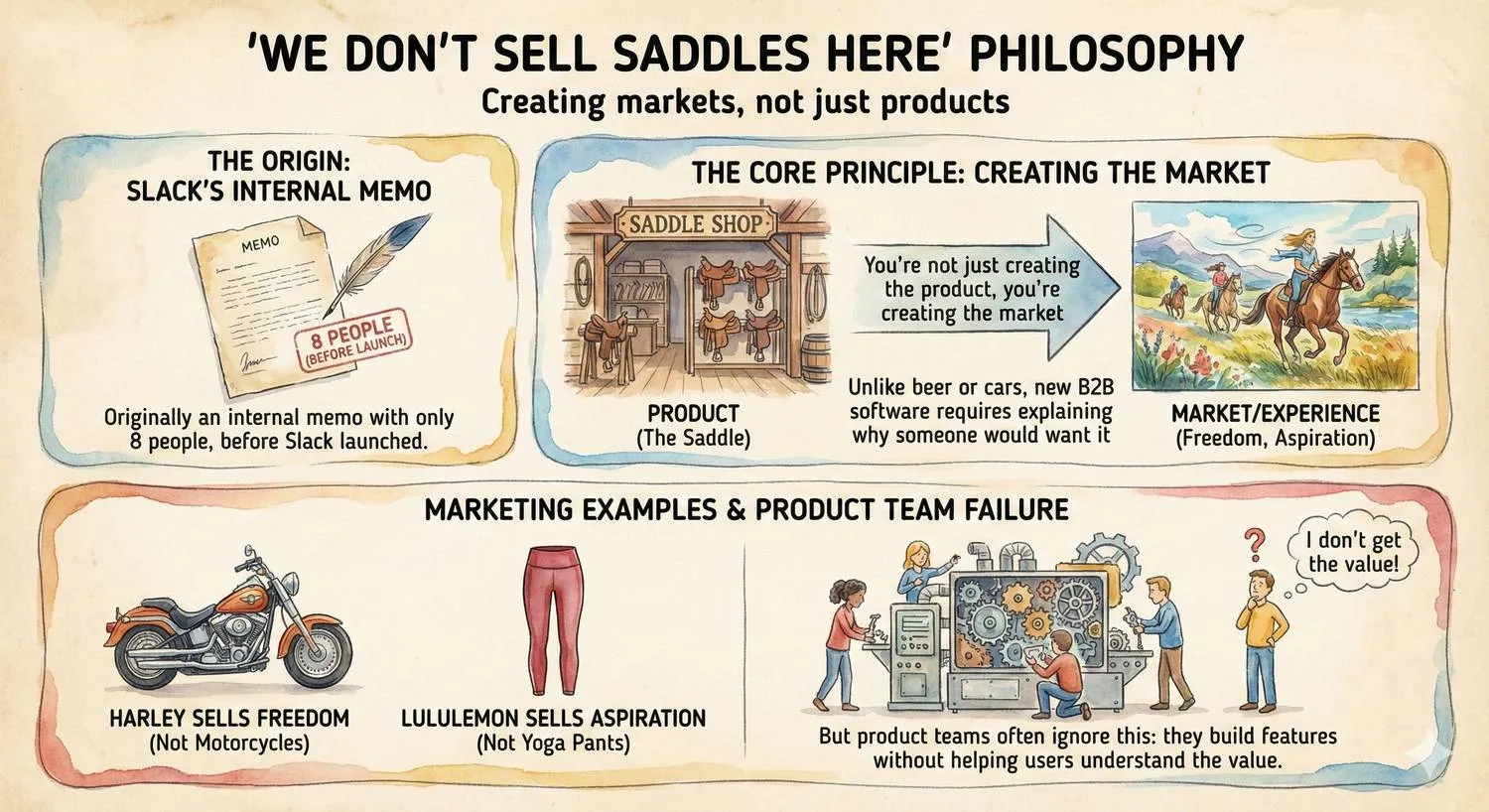
- “We Don’t Sell Saddles Here” Philosophy: Creating markets, not just products
- Originally an internal memo with only 8 people, before Slack launched
- Unlike beer or cars, new B2B software requires explaining why someone would want it
- You’re not just creating the product, you’re creating the market
- Not original to marketing (Harley sells freedom, not motorcycles; Lululemon sells aspiration, not yoga pants)
- But product teams often ignore this: they build features without helping users understand the value
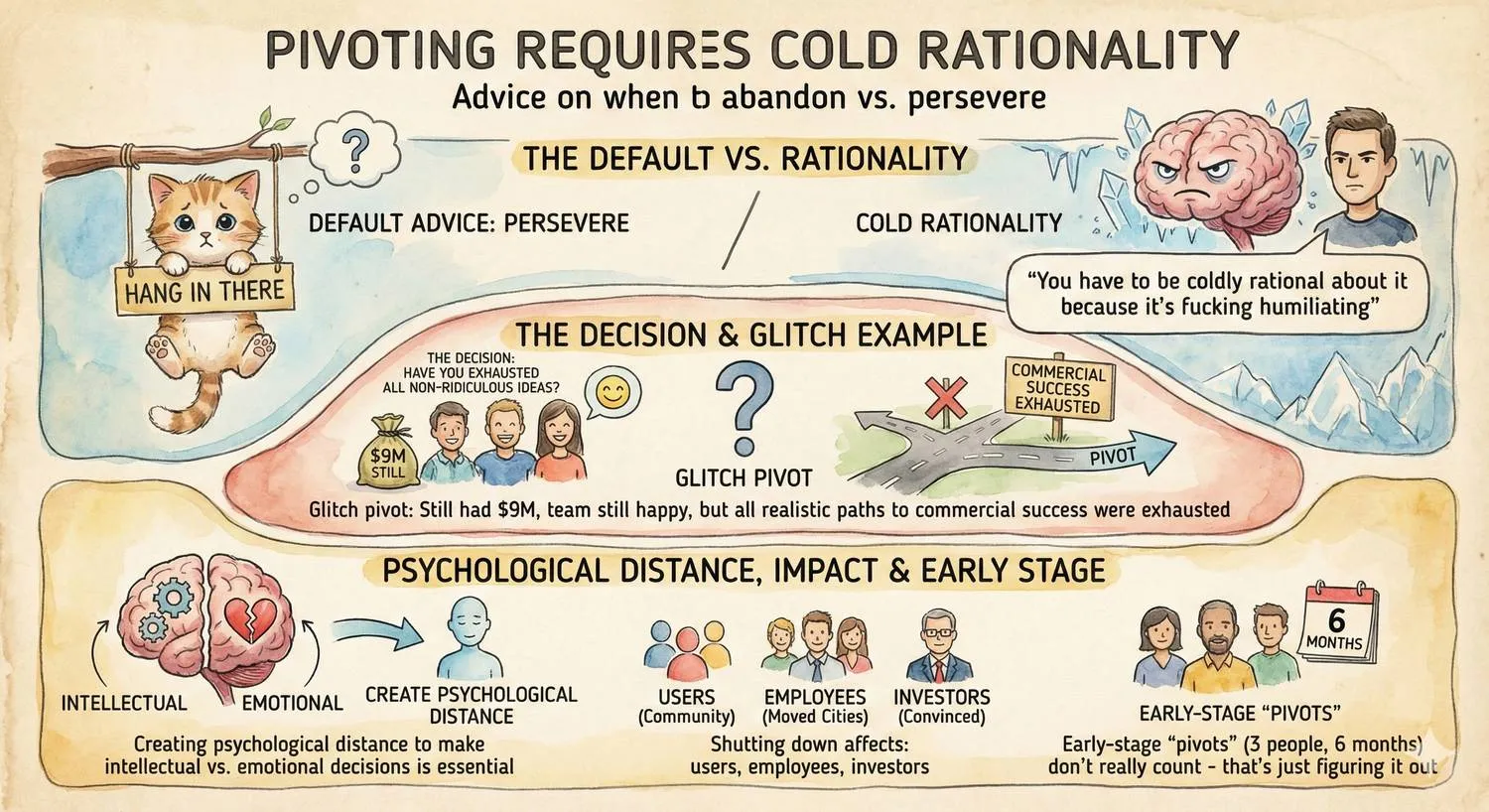
- Pivoting Requires Cold Rationality: Advice on when to abandon vs. persevere
- Default advice is always “persevere” (kitten hanging from branch: “hang in there”)
- “You have to be coldly rational about it because it’s fucking humiliating”
- The decision: Have you exhausted all non-ridiculous ideas?
- Glitch pivot: Still had $9M, team still happy, but all realistic paths to commercial success were exhausted
- Creating psychological distance to make intellectual vs. emotional decisions is essential
- Shutting down affects: users who built community, employees who moved cities, investors you convinced
- Early-stage “pivots” (3 people, 6 months) don’t really count - that’s just figuring it out
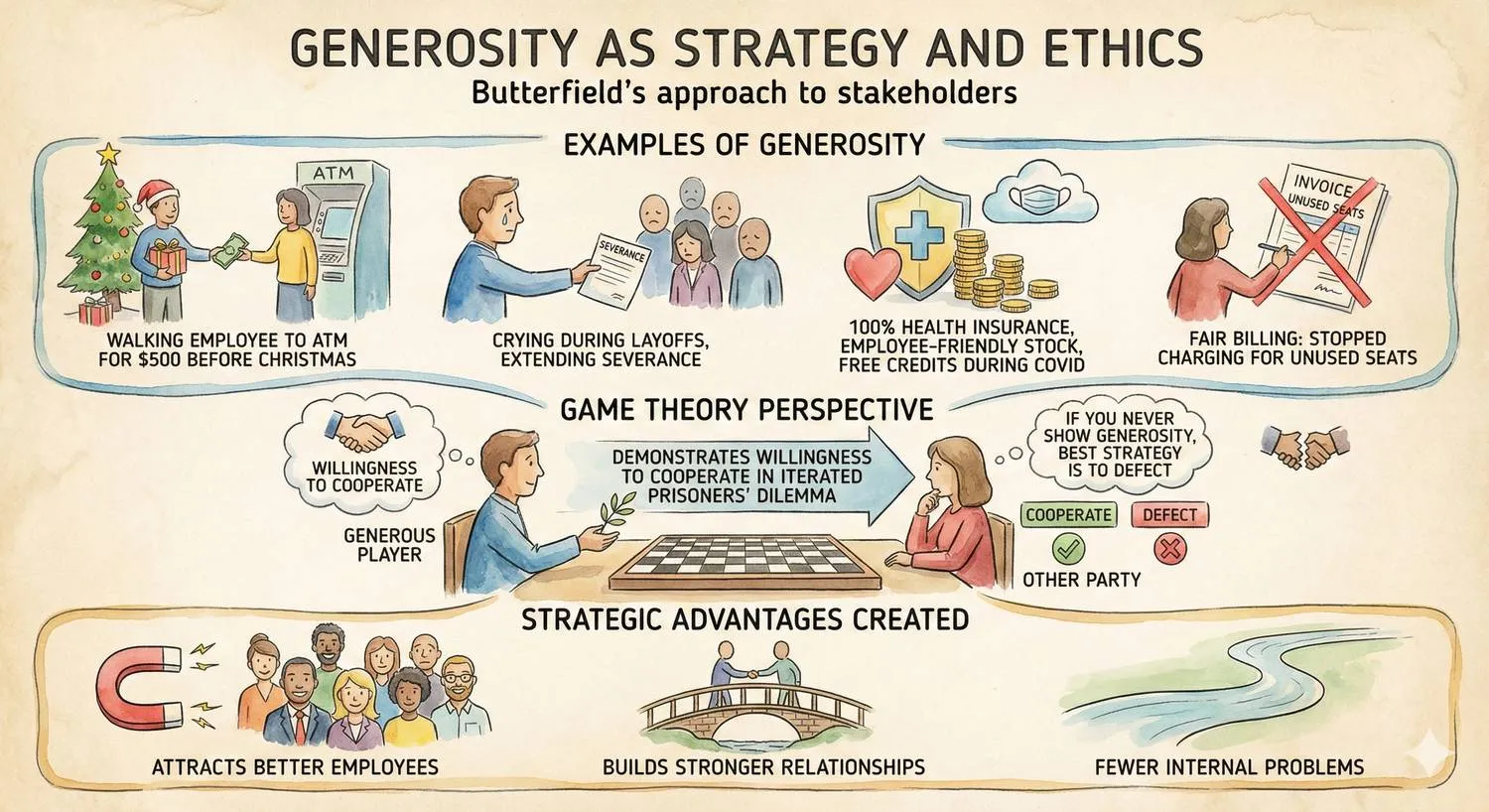
- Generosity as Strategy and Ethics: Butterfield’s approach to stakeholders
- Examples: Walking employee to ATM for $500 cash before Christmas, crying during layoffs, extending severance
- Paid 100% of employee health insurance, employee-friendly stock structure, free credits during COVID
- Fair billing: stopped charging for unused seats even though contracts allowed it
- Game theory perspective: Demonstrates willingness to cooperate in iterated prisoners’ dilemma
- If you never show generosity, other party’s best strategy is to defect
- Creates advantages: attracts better employees, builds stronger relationships, fewer internal problems
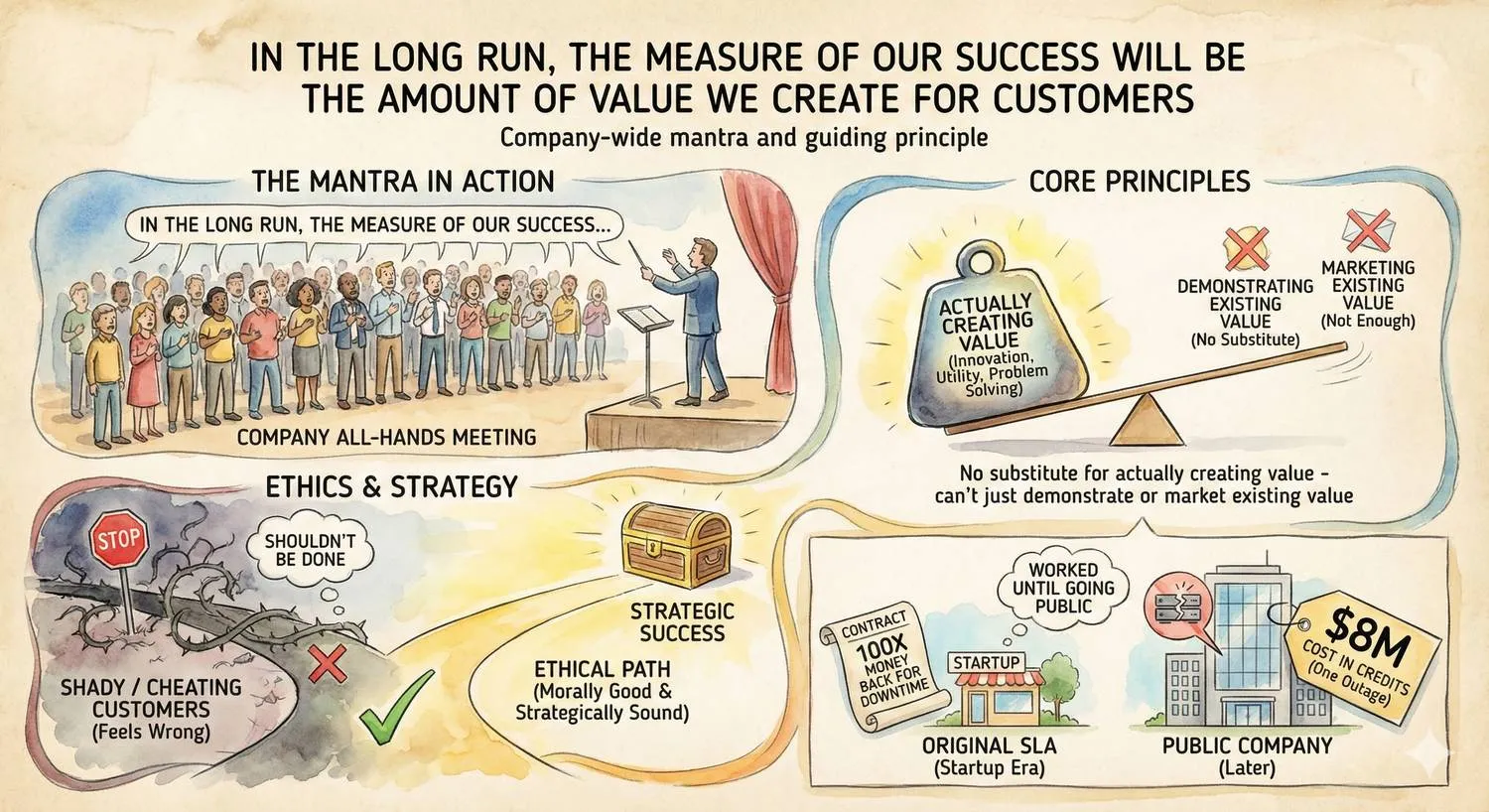
- “In the long run, the measure of our success will be the amount of value we create for customers”: Company-wide mantra
- Made everyone chant this at all-hands meetings
- No substitute for actually creating value - can’t just demonstrate or market existing value
- Anything that feels “shady” or like “cheating customers” shouldn’t be done
- Ethics aren’t just good morally, they’re strategically sound
- Original SLA: 100x money back for any downtime (worked until going public, then one outage cost $8M in credits)
💬 Notable Quotes & Evidence
“I feel like what we have right now is just a giant piece of shit. It’s just terrible and we should be humiliated that we offer this to the public.” - Context: Butterfield’s 2014 quote about Slack to MIT Technology Review. His team printed this on 40 pages and posted it on the wall. Represents his philosophy that if you can’t see limitless opportunities to improve, you shouldn’t be designing the product.
“If people could get over the idea of reducing friction as a number one goal or reducing the number of clicks or taps to do something and instead focus on how can I make this simple? How do I prevent people from having to think in order to use my software?” - Context: Core reframing of product design philosophy away from metrics toward user experience quality.
“Your failure to really be considerate and exercise courtesy and be empathic about other people’s experience is an advantage [we can create]” - Context: The “tilting your umbrella” story where only 1/3 of people move umbrellas to avoid poking others, adapted from Bezos’s “your margin is my opportunity.”
“If your software stops me and asks me to make a decision and I don’t really understand it, you make me feel stupid… Most people are like, ‘Oh, I’m dumb.’ If you’re causing people to think, in the best case it’s unnecessary use of their biological resources, and in the worst case, you’ve now made them feel bad emotionally, and they’re going to associate that with your product forever.” - Context: Explaining why “don’t make me think” matters beyond just efficiency.
“Everything is simple if you have no idea what you’re talking about… If something seems simple, probably you don’t understand it.” - Context: Butterfield’s Law explaining why organizational bloat happens - everyone thinks they need more resources because the problems seem more complex as they learn more.
“People end up performing enormous amounts of hyperrealistic work-like activities and have no idea that that’s what they’re doing… It’s superficially identical to work. We are sitting in a conference room and there’s something being projected up there and we’re all talking about it and that’s exactly what work is… but this is actually a fake bit of work.” - Context: Defining one of the most insidious problems in growing organizations.
🔍 Detailed Analysis
Strengths: This interview provides an unusually comprehensive and honest look at product leadership from someone who built two iconic products. Butterfield doesn’t rely on generic platitudes but instead offers specific, technical frameworks (utility curves, comprehension vs. friction) backed by concrete examples from Slack’s development. His willingness to criticize major products (Google Calendar, Gmail) while explaining why these failures matter demonstrates deep product thinking rather than superficial criticism. The integration of game theory, organizational psychology, and metabolic biology into product decisions shows sophisticated systems thinking.
The most valuable aspect is Butterfield’s willingness to discuss uncomfortable truths: that pivoting is “fucking humiliating,” that most people have bad taste (including presumably some listening), that organizations naturally drift toward dysfunction through Parkinson’s Law. He provides the “why” behind patterns others observe but don’t explain - why everyone wants to hire, why meetings proliferate, why products become incomprehensible.
Limitations: The interview occasionally lacks practical guidance on how to implement these insights in organizations with existing momentum. For example, how does a mid-level product manager at a 200-person company combat hyperrealistic work-like activities when they don’t control resource allocation? The advice about “cold rationality” in pivoting decisions, while accurate, doesn’t provide frameworks for knowing when you’ve truly exhausted possibilities versus just being tired.
Some examples (Google Calendar time zones, Gmail actions menu) feel dated or may have been addressed since the interview. The philosophical approach, while valuable, may be difficult to operationalize without Butterfield’s level of authority and company resources. The emphasis on craft and delight, while crucial for consumer-grade B2B products like Slack, may not apply equally to all product categories.
Unique Perspectives: The “utility curves” framework provides a missing mental model for feature investment decisions that goes beyond binary “ship/don’t ship” thinking. The reframing from “reduce friction” to “increase comprehension” challenges a deeply embedded product management assumption. Most uniquely, the “hyperrealistic work-like activities” concept names a phenomenon everyone experiences but few articulate - the subtle difference between real work and performing work. The owner’s delusion similarly explains a persistent user experience failure mode that otherwise seems inexplicable.
💡 Key Learnings
- Features exist on utility S-curves, not as binary states: Most features fail not because they’re bad ideas, but because teams don’t invest enough to reach the steep part of the value curve where users actually benefit significantly. Equally dangerous is over-investing past diminishing returns. The key question isn’t “should we build this?” but “where are we on the utility curve?”
- Comprehension beats friction reduction in most product contexts: Only reduce friction when users have high intent and specificity (authentication, checkout, reservation booking). For 70-80% of product design where users have low intent or don’t understand the value proposition, focus entirely on comprehension - helping users understand what something does and why it matters.
- Making users think has metabolic and emotional costs: Every unnecessary decision burns glucose and ATP. Worse, decisions users don’t understand make them feel stupid, creating negative emotional associations with your product. Design should minimize cognitive load, not tap counts.
- Organizations naturally drift toward hyperrealistic work-like activities: As companies grow, the supply of known valuable work decreases while the number of people (demand for work) increases. People will unconsciously fill time with activities that look like work but create no value. Leaders must actively ensure sufficient supply of real, valuable work.
- Taste creates sustainable competitive advantage because it’s rare: Most people don’t invest in craft, creating opportunity for those who do. The “tilting your umbrella” principle - small acts of consideration that others neglect - builds emotional connections that drive word-of-mouth growth. Your competitors’ lack of taste is your opportunity.
- The owner’s delusion prevents user-centered design: Teams forget that users arrive with minimal intent, maximum distraction, and zero context about your priorities. You must constantly “take a breath, pretend you’re a regular person” and re-evaluate whether experiences make sense to someone who doesn’t live inside your product.
- Parkinson’s Law drives organizational bloat inevitably: People hire because more reports correlate with career advancement, not because they’re stupid or evil. Every budget cycle, every head wants more heads. Without active countermeasures, organizations balloon beyond productive capacity. The solution requires continuous questioning of whether work is truly valuable.
- Pivoting requires exhausting all realistic possibilities first, then cold rationality: The decision to pivot is “fucking humiliating” and emotionally difficult, which is why most people avoid it until forced by running out of capital. Create psychological distance to make intellectual rather than emotional decisions. But don’t pivot early-stage (under 6 months) - that’s just normal exploration.
- Generosity is both ethical and strategically sound game theory: Demonstrating willingness to cooperate in repeated interactions encourages others to cooperate. Acts of generosity (paying full health insurance, fair billing, employee-friendly terms) attract better talent, build relationships, and prevent defection. Ethics aren’t separate from strategy.
- You must create the market, not just the product: Unlike beer or cars, new software requires explaining why someone would want it. You’re selling outcomes (horseback riding experiences) not features (saddles). Most companies build products but fail to do the equally important work of creating market understanding and desire.
🎬 Actionable Takeaways
For Product Managers:
- Before building features, explicitly map where you expect to be on the utility curve and what investment is needed to reach the steep part
- Replace “reduce friction” goals with “increase comprehension” for any feature where users don’t arrive with high, specific intent
- Audit your product for “owner’s delusion” - have someone unfamiliar use it while you watch, or personally attempt to complete tasks while pretending you don’t know the product
- Implement “don’t make me think” reviews: For every decision point, ask if users have sufficient context to make that decision without feeling stupid
- When showing multiple options, default to 2-3 common choices plus “Other” rather than displaying everything
- Add contextual warnings (like Slack’s “shouty rooster”) to shape behavior rather than just enabling capabilities
For Organizational Leaders:
- Establish “known valuable work to do” as an explicit management responsibility - regularly audit whether teams have clear, valuable objectives
- Watch for “hyperrealistic work-like activities”: meetings about meetings, elaborate processes for insignificant decisions, feature flags for trivial changes
- Question every request for additional headcount with “What work specifically would this person do that isn’t being done?” and “Why can’t current team do this?”
- Create company mantras (like “In the long run, the measure of our success will be the amount of value we create for customers”) and actually make people repeat them
- Build in periods of “divine discontent” - scheduled reviews of supposedly “complete” features to maintain quality as standards rise
- Demonstrate generosity strategically: Pay full benefits, be employee-friendly in major transactions, give customers credits proactively
For Founders and CEOs:
- Develop your taste deliberately through practice and observation - it’s learnable and creates defensible advantage
- Plan pivot decisions coldly and rationally before emotional investment makes objectivity impossible - define what “exhausted all possibilities” means in advance
- Focus as much on market creation (explaining why someone would want this) as product creation
- Accept that you’ll need to embarrass yourself by declaring your product “a giant piece of shit” to maintain improvement culture
- Build systems to counter Parkinson’s Law early, before the organization grows large enough to develop institutional momentum toward bloat