People keep asking me how to prepare for a tech interview, so here’s the list I keep sending. It’s what I used this year, and it worked for startups as well as big tech.
I signed NDAs, so I won’t name the companies or share any questions I got.
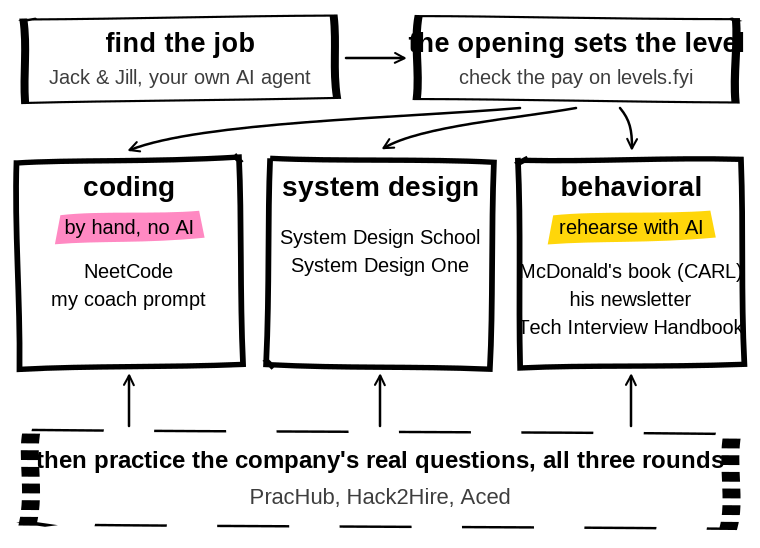
Know the level and the pay
When you apply for a specific role, whether on a job portal like LinkedIn or directly with the company, the level of that role is usually already set. When a hiring manager opens a job, they have to set a specific level. If the level is high, they need approval for it, because the level sets the comp. They have to justify it.
You can check the level and the pay on levels.fyi. I generally find the data pretty accurate, but be aware that you can go out of band if your performance or your experience is really good.
Coding
I used NeetCode, which is great for learning the patterns. LeetCode is similar.
This assumes you’ll be coding manually. In my experience, in every single coding interview I went to, I had to code manually and couldn’t use AI at all. Some companies are trying to make it AI-assisted, but I haven’t run into that in real life yet, so I wouldn’t know.
I have a prompt that helps me learn how to think about each problem. Paste it into ChatGPT or Claude along with the problem. It’s written for senior staff and principal roles, so change the level to yours. It works really, really well for me.
You need to act as a coding interview coach and help me learn how to best solve this problem using Python 3. This is for a coding interview, so I need the intuition for how it works and need to explain it well. I use NeetCode and can run the code with the tests, but I'd like you to help me go from the brute force to the fully optimized solution, and the journey between them, so I get full intuition. Before you write the solution, walk me through the intuition using diagrams, graphs, examples, etc. so that I understand the problem and how to solve it.

Try the visualizer first. If it's down, try a Mermaid diagram, then ASCII to illustrate.

When writing code, write comments to explain what is happening so I get more intuition and clarity, especially for dense code. Use clear code instead of code golfing. It's OK to be a bit more verbose; optimize for clarity. Make sure I have an intuitive understanding of the code.

Also write me talking points to explain my thought process, approach, etc.

Do not create any extra files for this, since I don't need a file.

Format your response as follows:
- Opening prose to say to the interviewer after seeing the problem, at a senior staff or principal engineer level.
- The intuition and how I would approach it. Show mastery over the brute force first, its time and space complexity, its problems, and how to get to the optimized solutions.
- Code for the brute force and optimized solutions. No need for 5 levels of solution, just 2 or 3 max.
- Visualization and intuition, walking through a non-trivial example. Make the visualization steppable and show the variables like a debugger so I can see what changes at each step. It's OK to only visualize the optimized solution.
- Tips and tricks and what to pay attention to.
- What follow-ups the interviewer would realistically throw at me, and how to solve them well.

Remember this interview is for senior staff and principal roles.Practice the company’s real questions
If you know which company you’re interviewing with, PracHub and Hack2Hire (it has a subreddit too) collect the questions candidates report from that company, sorted by how often they come up. Aced is another one. Practicing those beats random LeetCode.
They’re not just for coding and system design. These sites have behavioral questions as well.
System design
I used System Design School (that link is their full write-up of the top-K problem, a good one to start with) and the System Design One newsletter. PracHub and Hack2Hire have design questions too, but I liked System Design School better.
Behavioral
Reading the newsletter and the book is really good. Reading Mastering Behavioral Interviews by Austen McDonald all the way through teaches you how to think with the CARL framework (Context, Actions, Results, Learnings). It also has a memory jogger, so you can prepare a bunch of stories. His newsletter, The Behavioral, is worth reading back through, and the Tech Interview Handbook’s behavioral section is a good place to start too.
Most importantly, I used lots of LLMs to prepare for this. I tell my agent to research the CARL framework, the company I’m going for and the job ad. Then I ask it to give me a bunch of questions that might come up.
Then I use a transcription app (the ChatGPT app, the Claude app or Wispr Flow) and just talk through how I would answer. Then I ask the AI to rate how well I did against the CARL framework and what else I can improve. Iterate on it, and by the end you’ll have a bunch of answers and stories you can summon at will, and you can do really well.
You shouldn’t go into behavioral without practicing. It doesn’t decide your level, but you can definitely get down-leveled if your stories don’t answer the question well. You can also miss out on the job if the stories you tell aren’t senior enough for the role.
Jack & Jill
I’ve only used Jack & Jill, and I do recommend it, because it’s free for candidates, so you can just create a profile. Once you have a profile, you get recommended for jobs that companies are hiring for, and you can go talk to them. I had a few startups reach out for a bunch of different roles, and some big tech too.
Jack & Jill also finds jobs that fit what you’re looking for, which is pretty good. I actually enjoyed it, even though the job I ultimately took didn’t come from it (but that’s a separate thing).
Use AI agents
I use a combination of a bunch of stuff: my own Hermes agent, Claude Cowork, now Claude Duet, and ChatGPT Dots as well.
I keep an Obsidian vault with all my resumes and the jobs I’m applying to. I also have skills that check whether a job fits what I want: the distance, the work-life balance, the tech and product I’d be working on, and stuff like that.
The agent is super helpful because it can tailor your resume to a specific job and help you prepare for the interview. You can create a skill for each of them. Here’s a trimmed-down version of my job-fit skill to start from:
Check this job posting for fit against my constraints. Work through these steps in order, and stop at the first one it fails.

1. Pull the full job description, not just the header: title, level, team, location and office policy (quote it), any posted pay band, and the responsibilities and requirements. If you only got the header, say so. Don't guess.
2. Location: I live in [city] and will commute [how far, how often]. Pass, pass with a flag, or fail.
3. Pay: estimate total comp from the company, level and stage, using levels.fyi. My target is [number]. Say whether the equity is liquid now, soon, or not at all.
4. Fit: rate it High, Medium or Low against my resume (attached), in two or three sentences. Look at the tech and product I'd be working on and the work-life balance.
5. If it passes: research the company (stage, funding, recent news, the interview loop, and whether AI is allowed in it) and write me a short interview prep guide that points to the stories from my resume I should lead with.

Log every job you check, pass or fail, in one table so I never check the same job twice.If you have questions, let me know and I’ll see if I can help.